
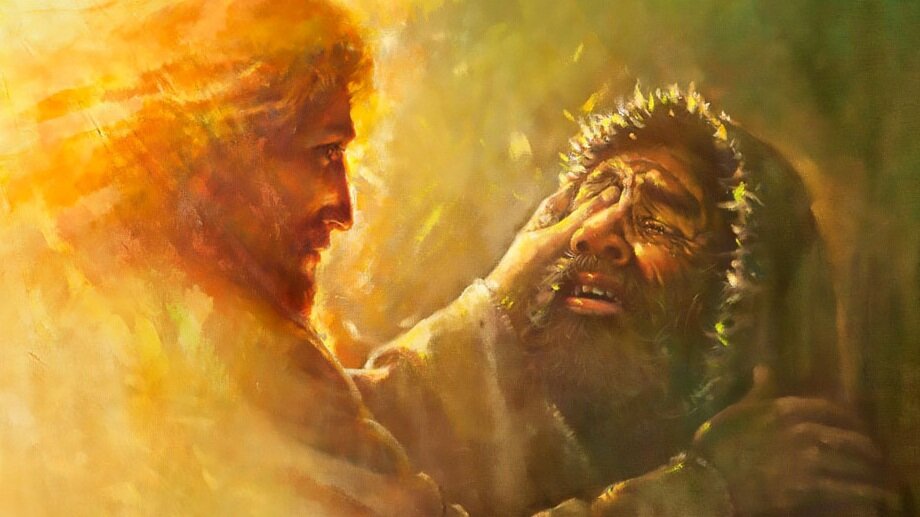
“Jesus went throughout Galilee, teaching in their synagogues, proclaiming the good news of the kingdom, and healing every disease and sickness among the people. News about him spread all over Syria, and people brought to him all who were ill with various diseases, those suffering severe pain, the demon-possessed, those having seizures, and the paralyzed; and he healed them. Large crowds from Galilee, the Decapolis, Jerusalem, Judea and the region across the Jordan followed him. (Matthew 4:23-25)
Here Jesus begins his public ministry. From the beginning, Jesus is never portrayed as merely a wandering sage or moral teacher. Rather, we witness him launching a political movement through his proclamation of “the good news of the kingdom” (emphasis mine). You don’t throw around “kingdom” language in the Roman empire nor challenge the local religious authority without consequence. It’s the sort of talk that will get you crucified! Jesus, however, is not political in the way we typically think of being ‘political’.
That is, Jesus doesn’t wield his authority and influence to grab at power and drive his agenda. Actually, he had the opportunity for that and turned it down (Matt. 4:1-11; Phil. 2:5-8). No, Jesus moves in true power and with unintimidated authority, not for personal acclaim or material gain but for the good of those he encounters — sees, hears, touches, heals — as a demonstration that the kingdom he proclaims is breaking in (Isaiah 61:1-2). He does not seek to schmooze the wealthy and elite but takes company with the obscure, lowly, and ostracized.
In at least a few ways, we (Christians/the Church) have veered from the way of Jesus in how we tend to navigate social, political, and religious spheres. We are often driven by a belief that charismatic leadership, cultural influence, and political power are vital to preserving and advancing Christ’s Kingdom. The problem is not with anything inherent in these pursuits but in our elevation of such things as either necessary or sufficient for fulfilling our mission with Christ in the world. At best, they supplement our work. At worst, they distract from, obscure, and ultimately undermine it. The mission and message of Jesus are devoured by our desire for preservation, power, and progress.
The shift occurs when what was once grounded in love becomes driven by fear. When we experience gains in the realms of socio-economic status, cultural influence, and political power we suddenly have something to lose. Something we are unwilling to lose. Something we are afraid to lose.
Fear is more seductive than wealth, status, influence, or power alone, or even collectively. It is fear that allows us to tolerate or even justify certain evils to either preserve or advance some ‘good’ end we intend. It was fear that drove Eve to take the fruit. Fear that God was withholding. Fear that God’s provision wasn’t enough. And fear that she wasn’t enough. Eve’s fear drove her to lust for something more. For security. status. For power. For control. For more. (Genesis 3:1-6).
Fear was at the root of every trial Israel faced in the wilderness. Fear drove Israel to demand a king. Fear crippled the kingdoms of Israel, time and time again. Fear prevented the religious leaders of Jesus’ day from embracing their Messiah. And fear moved the people and politicians to crucify him.
It was fear that Jesus contended against unto the very last drop of his blood upon the cross.
Fear moves us to hoard resources, abhor the needy, cower at conflict, and impose the Kingdom by force.
As with many of God’s people in Jesus’ day, fear blinds us to the way of the Kingdom, even as we cling to some warped vision of it.
Here is where I’m presently challenged by the way of Jesus in his proclamation of the Kingdom. If he refused the temptation for wealth, status, influence, and power throughout his ministry, how much more should we? Even at the height of his ministry, in his triumphal entry into Jerusalem with the crowds proclaiming his praises (Matthew 21:6-11), does Jesus wield his influence to win the favor of social elites or garner political allies? Does he align himself with political parties to serve his cause or advance the mission of his Kingdom? The answer is clearly, “NO.” Throughout his ministry he moved in a persistent and consistent fashion, doing justice, loving mercy, and walking humbly with his Father in heaven but never entrusting himself to the fickle and fleeting whims of the people (Micah 6:8; John 2:24).
Jesus wasn’t consumed by the hot-button issues of his day nor did he allow either himself nor his mission to be hijacked by the trends and currents of the prevailing culture. He moved through it all, not allowing himself to become embroiled in theological sectarianism (Matthew 22:23-33) or enmeshed in partisan ethics (Mark 12:13-17).
At every turn, Jesus resisted being pigeon-holed into any group. Jesus was creating a new community with a new identity centered upon and grounded within himself. This is where we’ve often gone wrong as the people of God. We’ve attempted to center Jesus upon our theological fixations, our politic, our ethic, to craft Christ’s Kingdom in our image and likeness for the advancement of our group to the exclusion of others, rather than centering ourselves upon Christ and “[his] kingdom come, [his] will be done, on earth as it is in heaven” (Matthew 6:10).
One final note, Jesus did not establish a nation-state nor political system. Rather, he established an ethic and way of life for the citizens of his Kingdom. And as his Kingdom was clearly “not of this world” (John 18:36), so we should expect a fair degree of conflict between the way of his Kingdom and the kingdoms of this world. There is no system, party, or political figure in this world that even mostly represents the interests of Christ’s Kingdom. The conflict of interest is inherent and evident as you read through Jesus’ Sermon on the Mount (Matthew 5-7). No matter how good the system, party, or politician might be, all of it is ultimately bound in the perpetual struggle for power and self-preservation. Jesus beckons us to a better way, not in abstaining from the public square but in faithfully presencing his Kingdom within it.
(Image Credit: Painting “Jesus Heals the Blind Man” by Yongsung Kim)
 Bear Theology